

The Official Notice #
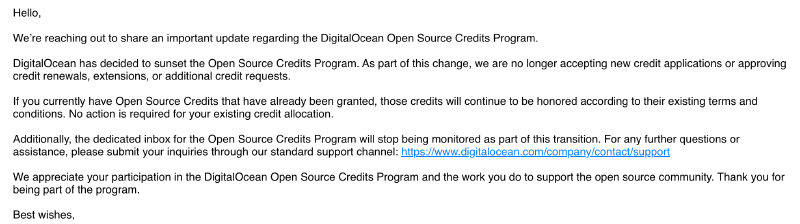
I just received an email from DigitalOcean announcing the end of its Open Source Credits Program. It caught me a little off guard. Although I had long suspected that DigitalOcean might discontinue this sponsorship program someday, when that day actually arrived, I still felt surprised and disappointed. Perhaps that is simply human nature: even when we have prepared ourselves for something, we cannot completely avoid the emotional impact when it finally happens.
The email says that credits already granted will remain valid, but no new credits will be given to open-source contributors. That much is certain. Many contributors currently in the program will be affected, myself included. I have been part of it for several years, so its end feels unfamiliar, almost like losing a long-term partner.
That is why I felt compelled to write this post. There is no particular purpose or grand point to it. I simply want to record a bit of my own experience and put some feelings and thoughts into words.
Looking Back #

I logged in to the DigitalOcean dashboard and checked when I first received free credits from the program. It turned out to be in 2020, more than six years ago. Time really does pass quickly. Over the years, I have mainly used DigitalOcean’s credits for cloud servers, networking, databases, block storage, and, to a lesser extent, Kubernetes and related container services. In truth, my usage on DigitalOcean has not been especially high, and I usually did not manage to spend all the credits from each grant. The program itself was also quite generous, with credit tiers based on an open-source project’s GitHub star count: more stars meant more credits could be requested. I no longer remember the exact tiers, and the original DigitalOcean page seems to have been taken down. The only reference I can now find is this page, which says the highest tier was $20,000. DigitalOcean’s original page, however, stated that projects with more than 10,000 stars could theoretically apply for unlimited funding. That was remarkably generous. Of course, there must have been a practical ceiling; most applicants probably never came close to it.
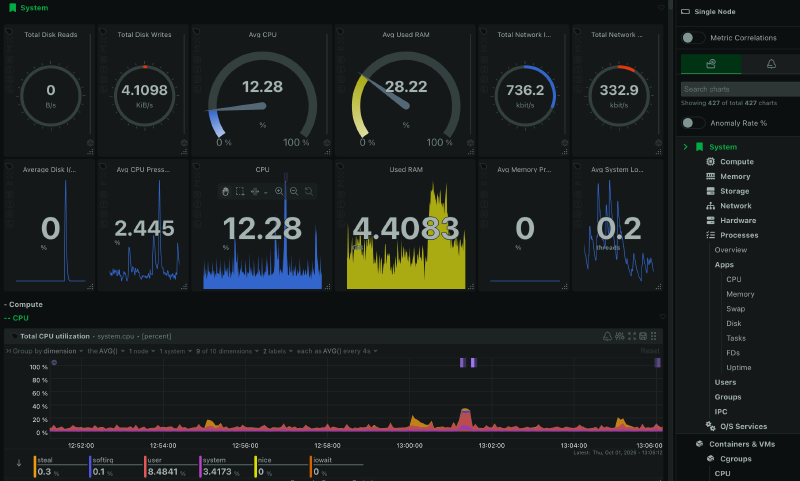
Although my DigitalOcean usage is modest, a closer look reveals quite a few services running there: my personal blog, databases, photo management, file management, and static asset servers, among others.
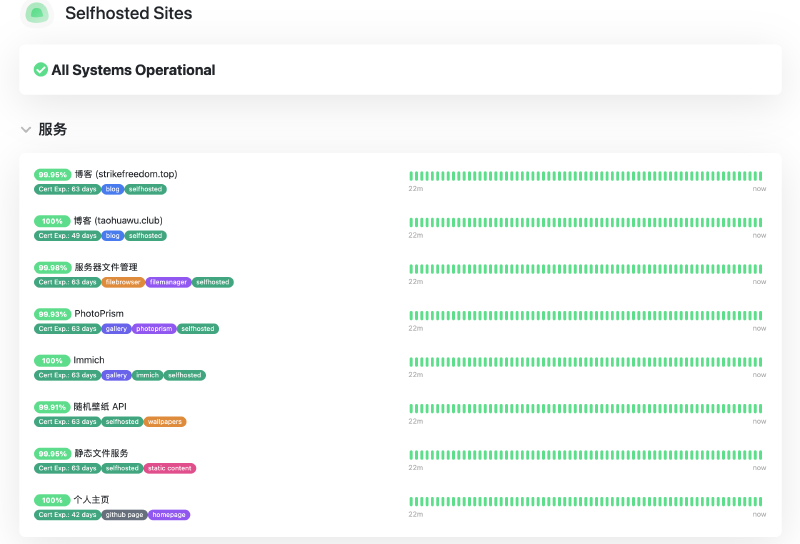
Having a cloud server of your own is like having a small space that belongs entirely to you, where you can freely build and manage all kinds of services. The open-source community is especially vibrant today, with an abundance of free software and tools. For someone like me, who enjoys tinkering with and experimenting with new technologies in their spare time, it is endlessly rewarding. I would recommend the awesome-selfhosted GitHub repository, which collects all kinds of self-hosted services and tools. If you are interested in self-hosting, it is a great place to find inspiration and resources.
The Feast Is Over #
I am not especially surprised that this kind of open-source sponsorship program is difficult to sustain. For a commercial company such as DigitalOcean, especially one that is not among the largest companies in the industry, it is hard to keep giving back to and supporting the open-source community indefinitely. Even technology giants such as Apple, Google, Microsoft, Meta, and Amazon have few long-running, stable open-source sponsorship programs. More often, their support for a project depends on their own strategy and interests.
These companies have also long benefited from the work of the open-source community without offering proportional support in return. Companies that rely heavily on open-source software often provide little direct funding to the projects they depend on. A few years ago, an Apple user asked Apple for help with an issue involving curl on macOS or iOS, requesting an update to the relevant documentation. Apple directed the user to the curl team instead. The response triggered substantial discussion and criticism, and curl founder Daniel Stenberg published a blog post criticizing Apple.
Daniel Stenberg wrote:
Imagine running a trillion dollar company that bundles various open source components into your products, making billions of dollars of profit annually. When one of your users reach out and ask for help, with the product you ship to your customers, you instead refer the user to the open source project. The project which is run by volunteers which you never sponsored with a cent.
Who would do something like that?
Cloud giants such as Google and Amazon have likewise been criticized for profiting from widely used open-source software without giving enough back. They have also clashed with maintainers of projects such as MongoDB, Elasticsearch, and Redis. These major open-source projects later formed companies of their own and found themselves in conflict with cloud providers. Some even changed their licenses to counter those providers. Such changes have naturally generated considerable controversy, but in my view the debate is also a sign of a healthy open-source community. Bringing these disagreements into the open is, at the very least, not a bad thing.
Compared with Apple and Google, DigitalOcean is much smaller and has more limited resources. Frankly, the fact that this open-source sponsorship program lasted for several years already reflects real goodwill. I have seen posts on Reddit saying that DigitalOcean has gradually closed various open-source sponsorship programs over the past year, so the end of the Open Source Credits Program seems understandable.
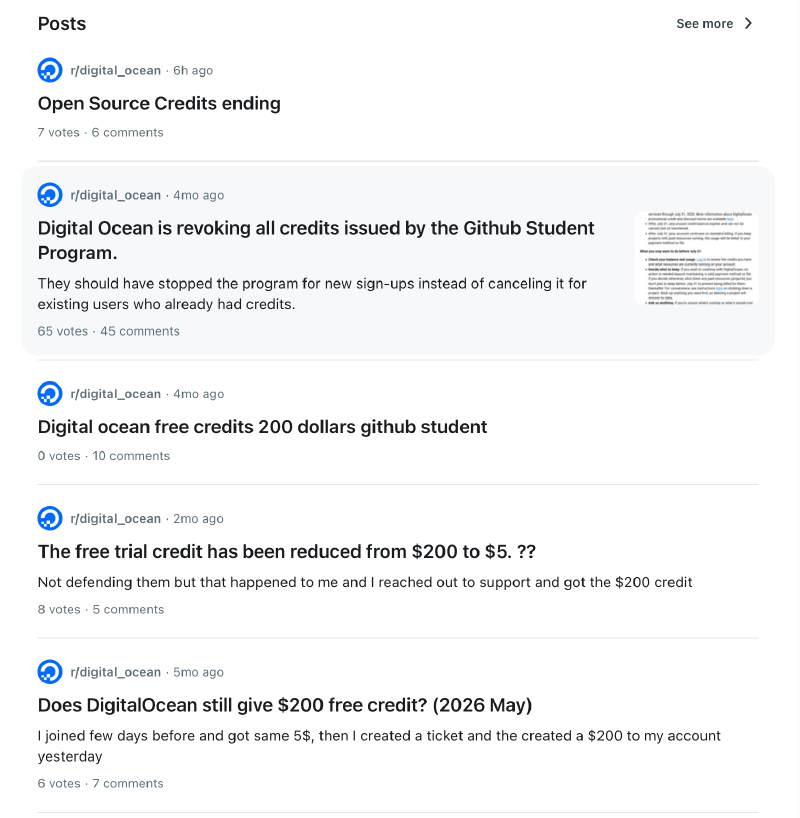
I have also seen people say that DigitalOcean is not ending support for every open-source project, but rather ending support for relatively small projects while continuing to sponsor those with especially large influence.
Even so, I remain grateful to DigitalOcean. Over the past six years, the free cloud services I received have been genuinely valuable; the accumulated cost would have been a significant sponsorship expense. With the global economy slowing down, it is foreseeable that companies will reduce spending on projects that do not generate profits. Even products with limited profitability may face cuts, so it is hardly surprising for an open-source sponsorship program to be discontinued. I do not know whether DigitalOcean’s decision is related to its own financial situation, nor whether the online rumors are true: that it is cutting support for smaller open-source projects and redirecting funds to more influential ones. Even if so, I understand the business decision. Companies must make the best choices they can with limited resources.
AI has completely changed the world. Computing may be one of the fields most deeply affected, and both commercial and open-source models have been fundamentally disrupted. Traditional models are becoming difficult to sustain, while new ones and new rules are taking shape quickly. The world may never return to what it was.
The feast is over.
Waiting for the Future #
No one can predict whether the future will gradually improve or become even worse. In this era where AI is everywhere, software development practices and ecosystems are undergoing profound changes, and the open-source community faces new opportunities and challenges. These changes may be unprecedented and could reshape the entire computing industry. The value of writing code and articles by hand seems to be repeatedly diminished, while we increasingly become supervisors and managers of AI rather than direct creators.
As agents such as Codex and Claude, along with other open-source agent harnesses, mature and become widespread, the possibilities for AI continue to expand. Dependence on agents is an irreversible trend, and history has repeatedly demonstrated as much. Their influence is no longer confined to coding: every industry is being reshaped by AI, including art, programming, writing, design, and mathematics. Whether we embrace it willingly or accept it reluctantly, AI is irreversible. Resistance is futile; learning to coexist with it is the only choice.
The future is something that makes us both afraid and hopeful.
Reply by Email